
Employee Mapping
& Placement
An enterprise-grade Hiring & Assessment Operating System designed to automate, standardize, govern, and scale candidate evaluation and assessment workflows.
- AI-powered CV vs Job fitment
- Competency-based evaluation methodologies
- Structured and governed assessment processes
- Large-scale assessment capabilities
- Centralized dashboards and analytics
- AI-powered assessment and placement visibility
01 — Assessment Methodology
Post-Discovery design — instruments, weights and thresholds confirmed after Discovery phase
Discovery & Framework Review
The organization's competency architecture, proficiency levels, existing performance data
Competency-to-Assessment Matrix
Each competency dimension mapped to validated assessment method
Multi-Dimensional Assessment
Technical · Cognitive · Behavioural · Leadership · AI Fit
Placement Decision Output
Placed · Develop · Redeploy · Review — with evidence trail
Competency-to-Assessment Matrix
Each competency mapped to the validated assessment methods that measure it.
02 — Assessment Approach by Group & Level
Methods and emphasis calibrated to responsibility scope and competency expectations.
03 — Evaluation Framework & Competency Alignment
Three-dimension scoring model anchored to the organization's own framework language and proficiency levels.
Competencies
Focus: Leadership · Behavioural · Technical
Multi-instrument assessment battery mapped to the organization's competency framework and proficiency level definitions
Potential
Focus: Cognitive · Adaptability · Growth capacity
Cognitive ability assessments and behavioural indicators identifying readiness for advancement
Job Fit
Focus: Skills · Experience · Behavioural alignment
AI CV-to-JD matching + automated comparison against the organization's defined placement criteria
Agentic AI Platform — Employee Mapping & Placement Intelligence
The Agentic AI engine powering employee mapping and placement decisions — evaluating CV-to-role fitment, competency alignment, placement readiness, and comparative suitability against predefined organizational criteria with evidence-based insights in seconds.
Phase 5: Rollout — Workforce Distribution Dashboard
Live placement outcomes across all five employee groups — strategic workforce snapshot at population level.
Placement Outcome Distribution by Employee Group (%)
Key Workforce Insight: Technical & Trade shows the highest Redeploy (16%) — targeted skills intervention recommended.
Illustrative sample data — final dashboard customised post-assessment to the organization’s structure and results.
Phase 5 · Rollout
Organisational Gap Analysis Heatmap
Competency gap concentration by function — drives L&D prioritisation and workforce planning post-placement.
| Function | Strategic Leadership | Technical / Functional | Cognitive & Reasoning | Behavioural / Core | AI-Enabled Fit |
|---|---|---|---|---|---|
| Strategy & Planning | 4 | 3 | 4 | 4 | 3 |
| Operations | 3 | 4 | 3 | 3 | 4 |
| Engineering & Projects | 2 | 5 | 4 | 3 | 4 |
| Finance & Commercial | 3 | 3 | 4 | 4 | 2 |
| People & Culture | 4 | 2 | 3 | 5 | 3 |
| Technology & Digital | 3 | 4 | 4 | 3 | 5 |
⚑ Workforce Intervention Signal: Engineering & Projects — Strategic Leadership gap (2). People & Culture — Technical gap (2). Finance & Commercial — AI Fit gap (2). These three clusters drive L&D prioritisation.
Illustrative sample data — actual heatmap generated post-assessment and customised to the organization’s function and competency structure.
From 22 minutes of assessment to a full executive readiness profile
The Executive Competency & Workforce Readiness Report — integrating AI CV Matching, Agentic AI Video Interview, and Leadership & Behavioural Assessment into a single placement-ready signal.
Transformational leadership, stakeholder alignment, collaboration, operational governance, team empowerment, and people-centric leadership capabilities.
Executive communication, strategic articulation, high-pressure decision-making, and executive presence within fast-paced transformation environments.
Leadership style spectrum
A balanced, people-centered profile combining transformational, democratic, servant and operational governance behaviours.
| Leadership Dimension | Distribution | Score |
|---|---|---|
Servant Leadership | 100% | |
Transformational Leadership | 98.25% | |
Democratic Leadership | 98.25% | |
Transactional Leadership | 95% | |
Laissez-faire Leadership | 93.25% | |
Autocratic Leadership | 80% |
93% role fit · GM, Capability Development
Capability Development & Operational Excellence — leadership, transformation and cross-functional execution capability strongly aligned to the role.
Alignment, Gaps & Development Pipeline
Demonstrated structured operational reasoning, stakeholder-oriented leadership responses, governance awareness, and consistent behavioural alignment across scenarios, with development opportunities in executive communication sophistication and strategic influence delivery.
- +Structured operational reasoning & governance orientation
- +Process-driven problem solving & logical response structuring
- +Collaborative stakeholder alignment & cross-functional coordination
- +Continuous improvement mindset & operational governance awareness
- +Workforce enablement, mentorship & leadership support orientation
- −Enhance executive-level communication precision & influence
- −Strengthen strategic framing, business impact communication, and enterprise-level positioning
- −Develop stronger executive presence under high-pressure and board-level communication scenarios
- →Executive communication & boardroom articulation
- →Strategic influence & executive storytelling
- →Executive presentation presence & leadership delivery
- →Executive facilitation, stakeholder influence & decision leadership
Targeted training based on assessment results
Assessment outcomes point to a focused development pathway — closing the communication & interview-performance gap (46%), strengthening executive decision-making under pressure, and scaling second-line leadership capability — while reinforcing existing strengths in servant, transformational and democratic leadership.
Enhance executive articulation, strategic storytelling, and leadership presence across complex stakeholder environments.
Strengthen prioritization, trade-off analysis, and executive decision-making in high-pressure operational scenarios.
Expand scalable leadership capability through delegation, ownership distribution, and second-line leadership development.
Build deeper exposure to operational compliance frameworks, policy environments, KPI governance, and regulatory structures.
Strengthen executive stakeholder engagement, influence communication, and cross-functional alignment capability.
Enhance enterprise-level transformation framing, organizational impact communication, and strategic change execution.
07 — Training Program Design & Execution
Design, deliver, and track workforce development programs at scale — six connected capabilities that turn assessment outputs into structured learning journeys, certifications, and measurable readiness.
Build workforce training programs
Create structured learning journeys for employees based on job role, department, leadership level, and competency gaps.
08 — Training Effectiveness & Workforce Impact
Measure workforce improvement, capability progression, and training effectiveness through AI-powered assessments and analytics — six connected capabilities that quantify the ROI of every learning journey.
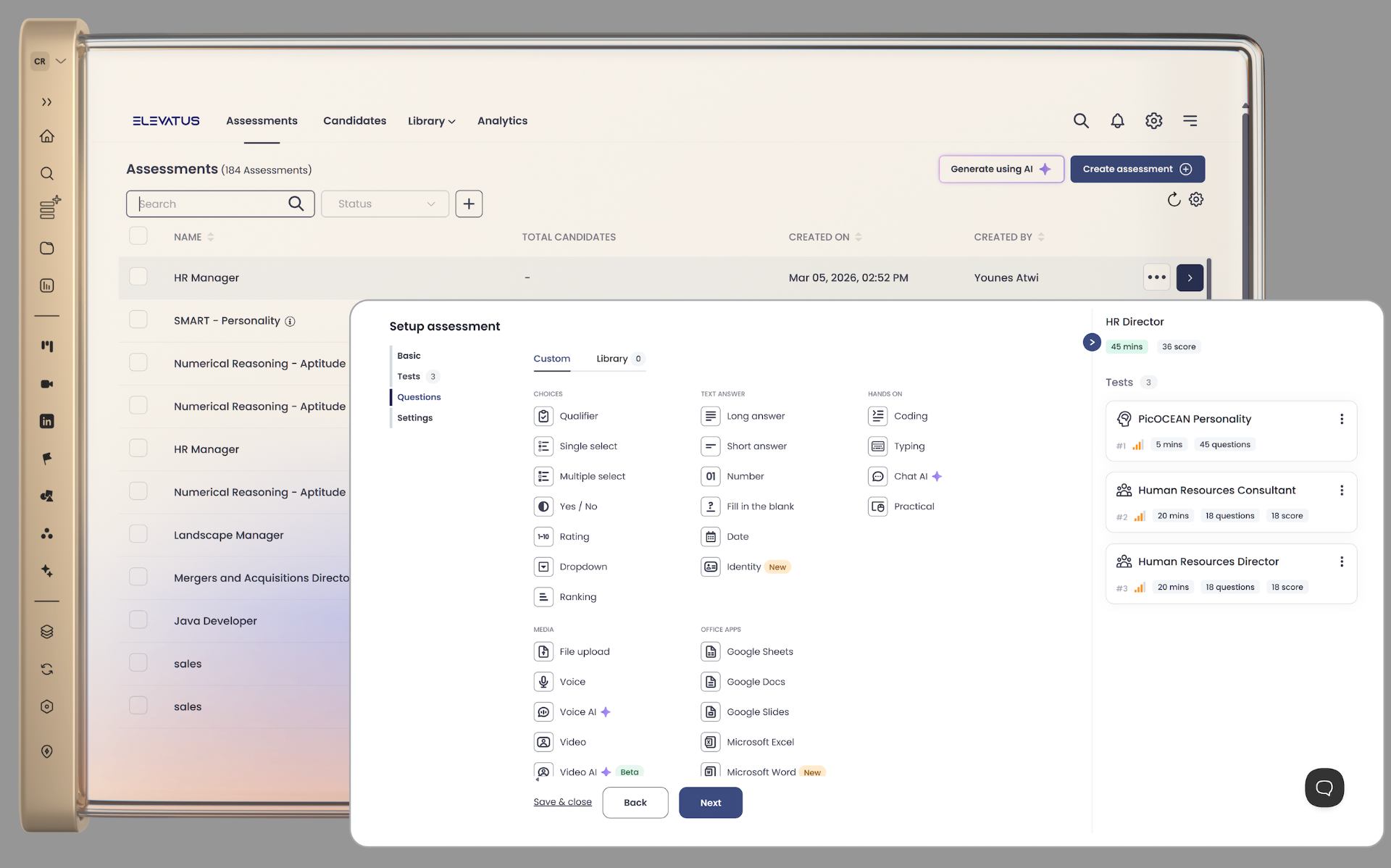
Evaluate workforce readiness after training
Launch customized post-training assessments to measure knowledge retention, competency improvement, workforce readiness, and learning effectiveness after program completion.
Analyze assessment results instantly
Instantly evaluate assessment performance, employee progress, success rates, and competency gaps through centralized analytics and reporting.
Build customized assessments & evaluations
Create knowledge tests, leadership & behavioural assessments, technical & role-specific evaluations, situational judgment assessments (SJT), and employee feedback surveys tailored to each training program or employee group.
Measure training impact on performance
Compare pre-training vs post-training results, competency progression, workforce improvement, and capability gap reduction.
Connect training outcomes to organizational KPIs
Provide centralized dashboards and reports to measure training completion rates, assessment performance, workforce readiness, and organizational capability progression.
Launch learning feedback & satisfaction surveys
Collect employee feedback, training satisfaction insights, learning engagement indicators, and continuous improvement recommendations.